
Quick Facts
Efficacy: ★★★★★
Safety: ★★★★★
Value for Money: ★★★☆☆
Scientific Research: ★★★★☆
For Skin Type: TAll types, including sensitive
Type: Esterified derivative of tranexamic acid
Main Function: Anti-melanogenesis, anti-erythema, anti-inflammatory
Suitable for: All skin types, safe for sensitive skin
What is Cetyl Tranexamate Mesylate: Definition and Origin
The advanced form of tranexamic acid
Cetyl tranexamate mesylate is an advanced esterified form of tranexamic acid, specifically developed to overcome the main limitation of standard tranexamic acid: poor skin penetration. While traditional tranexamic acid is a water-soluble molecule that struggles to cross the lipophilic stratum corneum of the skin, cetyl tranexamate is a lipophilic molecule that effectively penetrates the vital layers of the epidermis where melanocytes reside.
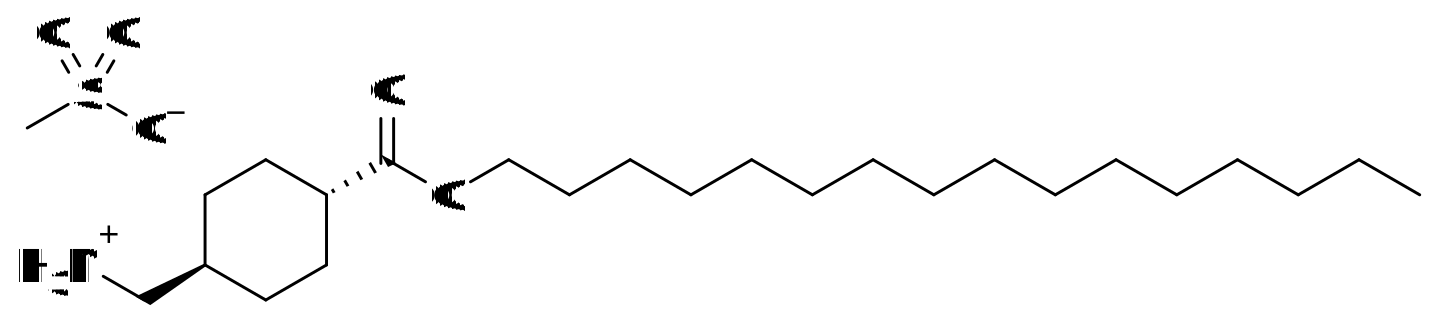
Chemical formula of cetyl tranexamate mesylate.
How cetyl tranexamate mesylate is produced
This patented form is converted into free tranexamic acid by epidermal cutaneous enzymes once it has penetrated the skin, ensuring the release of the active ingredient exactly where it's needed.
283% higher bioavailability: the scientific data
Studi di penetrazione cutanea con spettroscopia Raman confocale dimostrano che il cetyl tranexamate raggiunge l'epidermide vitale entro 1 minuto dall'applicazione, con una biodisponibilità superiore del 283% rispetto a quella dell'acido tranexamico standard alla stessa concentrazione.
How Cetyl Tranexamate Mesylate Works on the Skin
Penetration and conversion mechanism
The mechanism of action of cetyl tranexamate is identical to that of tranexamic acid, but with significantly superior efficacy thanks to optimized penetration. Once penetrated into the viable epidermal layer, cetyl tranexamate is rapidly hydrolyzed by dermal esterases: 88% converts to free tranexamic acid within 20 minutes, while the remaining portion continues conversion progressively.
Anti-melanogenesis action: upstream blocking
The released tranexamic acid inhibits plasmin activity, an enzyme that stimulates the production of pro-inflammatory mediators such as prostaglandins and arachidonic acid. These mediators normally activate melanocytes by increasing melanin synthesis. By blocking this cascade upstream, cetyl tranexamate prevents hyperpigmentation before it forms, also reducing erythema and inflammation.
Difference compared to other brightening agents
Unlike direct brightening agents like hydroquinone that inhibit tyrosinase, cetyl tranexamate acts preventively on the signals that activate melanocytes, resulting in significantly less irritation and suitability even for sensitive skin.
What cetyl tranexamate mesylate is used for: skin problems solved
Clinical results: melasma and hyperpigmentation
A clinical study on 35 women who applied cetyl tranexamate at 2% twice daily for 8 weeks documented remarkable results: 16.9% reduction in melanin index and 34.3% reduction in erythema. After just 2 weeks, 79.3% of participants had already noticed improvement in skin tone, 78.6% reduction in dark spots, and 77.1% improvement in facial redness.
Main indications: when to use it
Main indications: when to use it
Cetyl tranexamate is particularly effective for melasma, post-inflammatory hyperpigmentation, diffuse redness, and erythema. It has proven superior to standard tranexamic acid formulations in terms of speed of action and consistency of results.
Preventive use after aesthetic procedures
It is also used preventively before laser procedures, peels, or microneedling to minimize the risk of reactive hyperpigmentation.
Dual action: spots and redness together
The combination of anti-melanogenesis and anti-erythema action makes it unique among brightening ingredients: while most treat only discoloration, cetyl tranexamate simultaneously improves skin tone and reduces redness.
Cetyl tranexamate mesylate concentration: how much is needed to work
Optimal concentration: 2% clinically tested
The clinically tested and validated concentration is 2%, which has demonstrated significant reduction in melanin and erythema without side effects. The manufacturer's recommended usage range is 1-5%, with 2% considered optimal for efficacy-safety balance.
Why higher concentrations aren't necessary
Unlike standard tranexamic acid where concentrations above 5% bring no additional benefits due to limited penetration, cetyl tranexamate maintains efficacy proportional to concentration thanks to its lipophilicity. However, the 2% concentration has already proven highly effective, making the use of higher percentages unnecessary.
Bioavailability comparison: cetyl tranexamate vs tranexamic acid
A comparative study showed that 3% cetyl tranexamate provides bioavailability equivalent to 1% standard tranexamic acid, confirming the 283% advantage in skin penetration. This means that formulations with cetyl tranexamate can use lower concentrations while achieving superior results.
Cetyl tranexamate mesylate and other actives: what to combine and what to avoid
Chemical compatibility: cationic and non-ionic ingredients
Cetyl tranexamate is cationic, therefore it presents typical incompatibilities with anionic ingredients. However, it is perfectly compatible and synergistic with non-ionic and cationic ingredients.
Winning combinations to enhance efficacy
Winning combinations include niacinamide, with which it forms a powerful brightening combination by mutually enhancing efficacy. It works excellently with vitamin C in the form of ascorbyl glucoside, retinoids like oleyl adapalenate, and azelaic acid. The combination with curcumin or tetrahydrocurcumin offers complementary brightening action.
Ingredients to avoid: anionic incompatibilities
Ingredienti da evitare sono tensioattivi anionici forti, polimeri anionici come carbomer o xanthan gum non modificati e acidi ad alta concentrazione che possono destabilizzare la formulazione. Si consiglia cautela con acidi esfolianti AHA/BHA superiori al 10%, che potrebbero aumentare la sensibilità cutanea, sebbene non vi siano incompatibilità chimiche dirette.
Is it safe? Side effects and contraindications
Dermatological safety testing
Cetyl tranexamate has passed extensive safety testing, including Modified Human Repeat Insult Patch Test on 54 subjects without questionable adverse reactions. Clinical studies on 35 women for 8 weeks reported no significant side effects. Cytotoxicity evaluations on HaCaT cells show very low toxicity.
Safe for sensitive skin
È dermatologicamente testato sicuro per tutti i tipi di pelle, inclusa quella sensibile. A differenza dell'acido tranexamico orale, che può causare disturbi gastrointestinali o alterazioni mestruali, la forma topica esterificata presenta un profilo di sicurezza eccellente senza assorbimento sistemico significativo.
Use during pregnancy and breastfeeding
No specific contraindications are known for topical use. Use during pregnancy and breastfeeding is considered safe for cutaneous application, not presenting the potential risks of systemic oral use. However, a preliminary patch test is advisable to exclude individual sensitivities.
Best products with cetyl tranexamate mesylate from Melicor
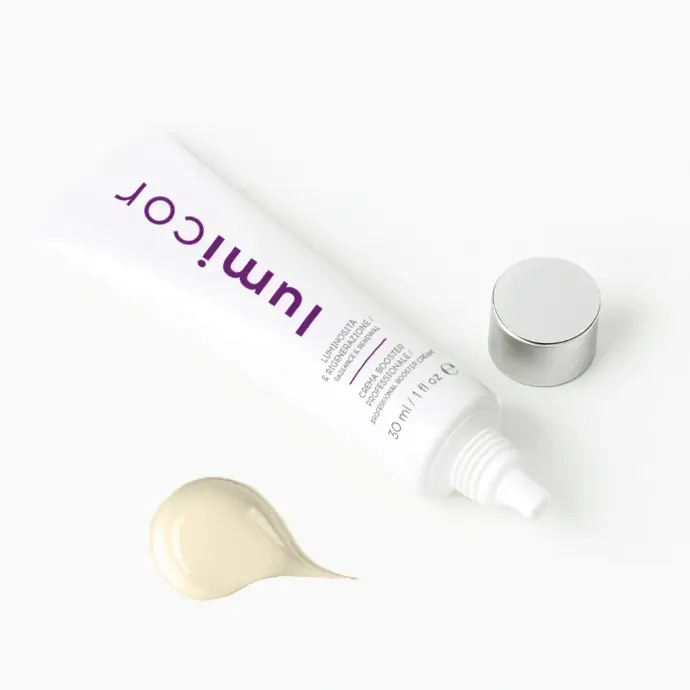
Lumicor booster cream
Lumicor Professional Booster Cream contains cetyl tranexamate mesylate, the highest concentration available on the market. An innovative formula with cetyl tranexamate, a third‑generation adapinoid, and bioavailable curcumin: triple action against dark spots, redness, and signs of aging.
Optimized formulation for maximum efficacy
The cream is formulated at pH 4.35 optimal for stability and penetration of cetyl tranexamate. It also includes niacinamide, ectoin for cellular protection, licorice and tormentil extracts for complementary soothing action. The lightweight gel-cream texture allows rapid absorption without greasy residue.
How to use Lumicor: application protocol
Recommended application: twice daily on clean skin, allow to absorb for 15 minutes before applying mandatory SPF 50 sunscreen in the morning. Visible results: redness reduction in 2 weeks, dark spot lightening in 4 weeks, maximum improvement in 8-12 weeks.
Frequently Asked Questions
Is cetyl tranexamate better than regular tranexamic acid?
Sì, il cetyl tranexamate offre una biodisponibilità superiore del 283% grazie alla sua natura lipofila, che permette penetrazione efficace nello strato epidermico vitale. Gli studi mostrano risultati clinici superiori in tempi più brevi.
How long does it take to see results?
First improvements are visible after 2 weeks with redness reduction. Dark spot lightening begins at 4 weeks, with maximum results at 8-12 weeks of consistent use.
Can I use it with vitamin C and retinol?
Yes, cetyl tranexamate is compatible with vitamin C and retinoids. To minimize potential sensitivity, alternating application is recommended: cetyl tranexamate morning and evening, retinoids only in the evening.
Is it safe for sensitive skin?
Yes, cetyl tranexamate has demonstrated excellent safety even on sensitive skin. It is significantly less irritating than hydroquinone and many other brightening agents.
Do I need to use sunscreen?
Absolutely yes. The use of broad-spectrum SPF 50 is mandatory during treatment with any brightening ingredient, including cetyl tranexamate, to prevent new UV-induced hyperpigmentation.
Scientific Studies: What the Research Says
Study 1: Superior bioavailability and skin penetration
Studio in vivo con spettroscopia Raman confocale ha dimostrato che il cetyl tranexamate fornisce il 283% di principio attivo in più nella pelle rispetto all'acido tranexamico standard all'1%. L'88% di cetyl tranexamate si converte in acido tranexamico libero entro 20 minuti, raggiungendo efficacemente l'epidermide vitale, dove risiede l'attività melanogenica.
Technical Documentation, 2024
Study 2: Clinical efficacy on melasma and erythema
Studio clinico su 35 donne con applicazione di cetyl tranexamate 2% due volte al giorno per 8 settimane. Risultati: riduzione dell'indice di melanina del 16,9% e riduzione dell'eritema del 34,3%. Dopo 2 settimane: 79,3% miglioramento del tono, 78,6% riduzione delle macchie, 77,1% riduzione del rossore. Nessuna reazione avversa.
da Silva Souza et al., Journal of Cosmetic Dermatology, 2021
Study 3: Prodrug strategy to improve skin absorption
Study on alkyl ester derivatives of tranexamic acid demonstrates that esterification improves skin penetration by 2-3 times. The esters are rapidly hydrolyzed releasing active tranexamic acid in less than 2 hours. Safety assessments show no skin irritation and low cytotoxicity.
Zeng et al., RSC Advances, 2024
Study 4: Topical mechanism of action
Review completa sul meccanismo dell'acido tranexamico topico nel trattamento melasma. L'azione schiarente coinvolge soppressione della produzione di citochine e mediatori chimici che stimolano la melanogenesi tramite l'attivatore del plasminogeno di tipo urochinasi derivato dai cheratinociti.
Maeda, Cosmetics, 2022
Study 5: Validated optimal concentrations
Studio clinico dimostra che una concentrazione del 3% di acido tranexamico topico è efficace quanto la combinazione idrochinone-desametasone, con un profilo di sicurezza superiore. Il range di concentrazioni ottimali identificato: 2-5%.
Cosmetics, 2024